
Burnout Box
The area just before the starting line that is sprayed down with water, so you can do a quick burnout to warm up the tires or slicks for better traction and get rid of any debris lodged in them.
60-Foot Timer
Measures the time it takes the car to cross the first 60 feet of the track. This shows you how well the car launches, which affects your elapsed times.
660-Foot Timer
Measures elapsed time at the halfway point of a quarter-mile track. At some tracks, speed (in miles per hour) is also recorded. Some tracks also have timers at 330 and 1,000 foot intervals.
Mile-Per-Hour Timer
Also known as the speed line, this timer is located 66 feet before the finish line. It records the car’s average speed between it and the finish line. This is the mile per hour figure on your time slip.
Finish Line
When you cross the light beam at the end of the quarter-mile, you stop the ET clock. The amount of time (in seconds) between when the timer was activated and when it stopped is the ET figure on the time slip.
Shutdown Area
The area past the finish line, usually a quarter-mile or more in length, where you can safely slow the car down to take the turnout to the time slip booth. If something goes wrong and you can’t stop the car, most tracks have a sand trap, net, or other setup at the end of the shutdown to stop you.

Pre-Stage Indicator Lights
Round yellow bulbs that warn you when you are getting close to the starting line and the “staged” (ready to race) position.
Stage Indicator Lights
A second set of round yellow bulbs that tell you when you are on the starting line and ready to race. The bulbs light up when the front wheels of the car cross a beam of light that goes to a set of photo cells. These cells trigger the timer when the car leaves the light beam.
Countdown Lights
Round amber floodlights that count down to the green “go” light. There are two types of countdowns or starts. The pro start flashes all three lights simultaneously, with a .400 second difference between the amber and green lights. This is called a Pro or .400 Tree. The bracket starts flashing one light at a time, with a .500 second difference between the last amber and the green light. This is known as a .500 or Sportsman Tree.
Green Light
This is the one you’re waiting for. When the green light flashes, it means you’re free to mash the gas pedal and make a run. This is called the launch.
Red Light
If this bottom bulb flashes, you’re out. The red light will go off when you leave the starting line before the green light is activated, resulting in a disqualification. Known as “redlighting”, this action automatically gives the win to your opponent. Most drivers try to begin their launch just as the last of the three amber lights goes off. That puts the car in motion when the green light activates. This is where most bracket races are won or lost, so time practicing your staging and launching techniques is time well spent.
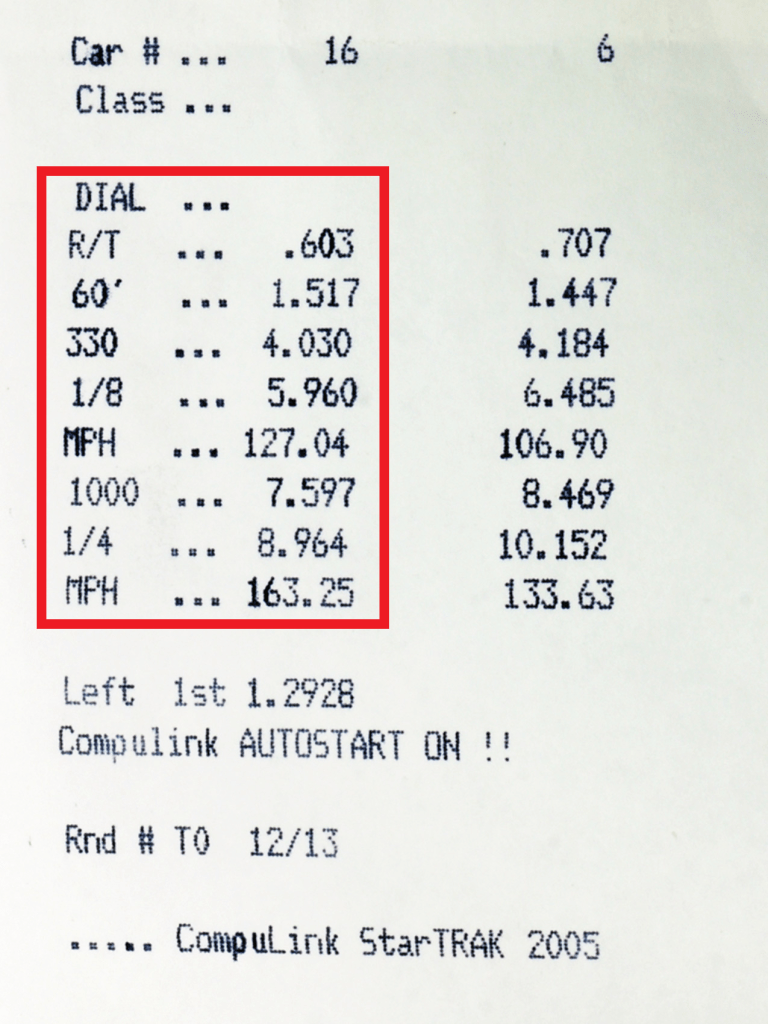
Timeslip
After you make a run, the officials in the little booth at the end of the track will hand you a piece of paper with numbers all over it. This paper is called the timeslip.
The timeslip provides a wealth of information about a run. It tells you how well you launched, how quick and fast you went at various points on the track, and what your final ET and mile per hour were. And if you were racing against an opponent, the timeslip tells you how they did, too
Car Number
Most cars are assigned numbers at official races.
Class
Marked if running in an official race. Not used for “test and tune” sessions.
Dial-In
This is the elapsed time you think your car will run.
Reaction Time
This tells you how quickly you reacted to the green light on the Christmas Tree. In this case, it is set as a .500 second or PRO Tree. You want your RT to be at or as close to .500 as possible. If you react faster than that, you’ve just redlighted.
60, 330, 1/8, MPH, and 1000 ET and MPH Times
These figures give you the elapsed times at the 60 foot, 330 foot, 660 foot or eighth-mile, and 1,000 foot marks. You also get the mile per hour figure at the 660 foot mark and MPH Quarter-Mile ET and MPH These are your finishing elapsed time and mile per hour numbers. When it comes to bragging rights, these are the ones that count!